How to get a contractor license in California
The whole path on one page: who needs a license, what CSLB asks for, each step in order, what you pay and how long it takes.
On this page12 sections
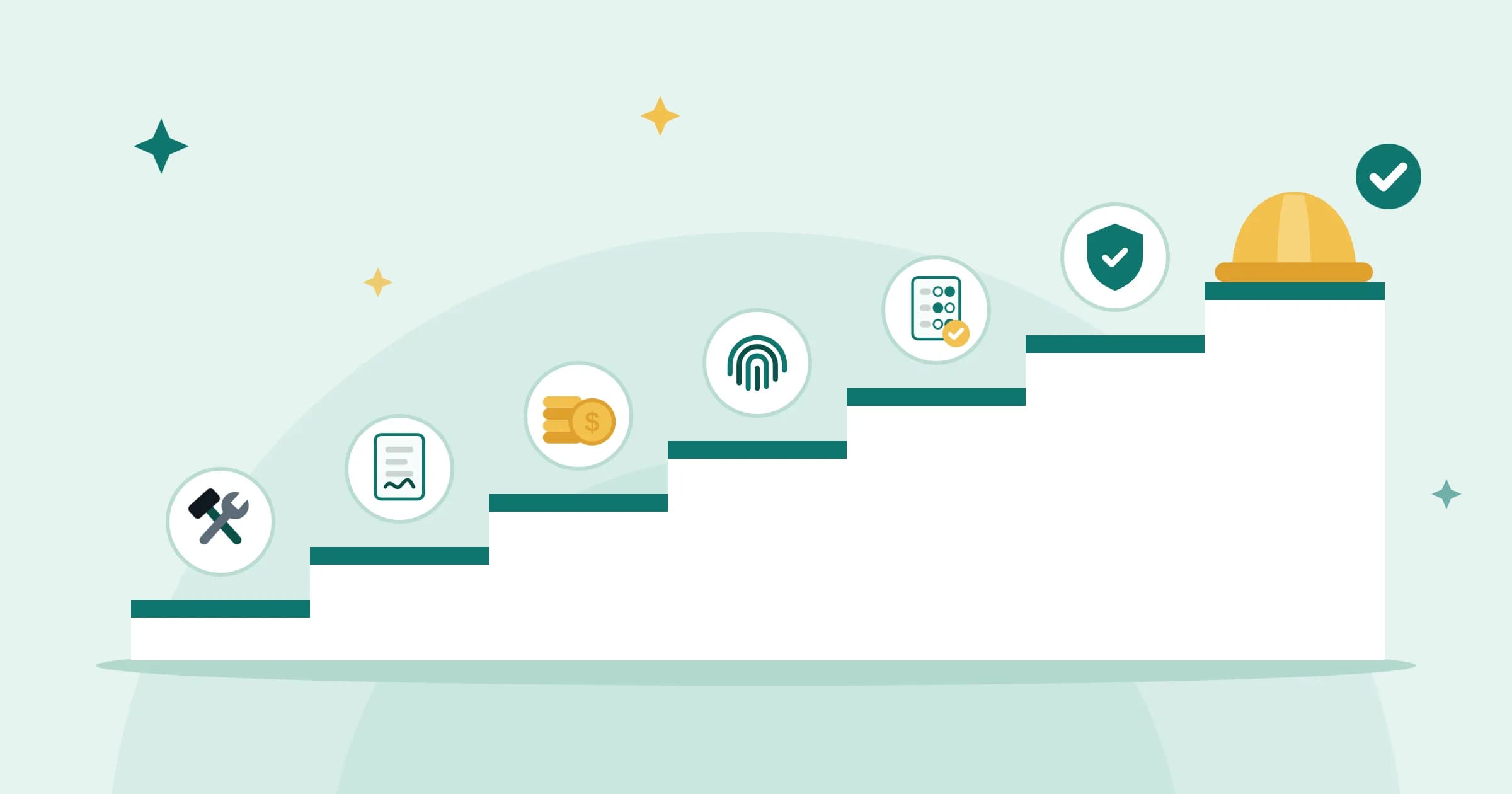
In California, you need a contractor license for any construction job priced at $1,000 or more with labor and materials, and for any job that needs a building permit or hired help. The Contractors State License Board (CSLB) issues the license. The path is 4 years of experience, an application, exams (usually two) and a bond. What people call a "general contractor license" is the Class B license, covered in our Class B general building contractor license guide.
California contractor license at a glance
- Who needs one. Anyone who builds, repairs or remodels for a customer when the job is $1,000 or more, needs a building permit or uses hired help. Do you need a license?
- What you need. Age 18 or older, a Social Security number or ITIN, 4 years of experience in the last 10 years, passed exams (usually two), fingerprints and a bond. What qualifies you
- How long. CSLB gives no current total. Between August 2025 and July 2026, applications for a new license with exams waited an average of 1.4 to 3.5 weeks, depending on the month, before CSLB first opened them. Applicants most often report 3.5 to 6 months from application to license. How long it takes
- How much. $450 to apply and $200 or $350 when the license is issued. Fingerprints, exams, the bond and insurance are paid separately. What it costs
- How hard. Usually two closed-book exams of 3.5 hours each. If you don't pass, you can retake after 21 days. How hard it is
The steps, in order
- Check that you're ready to apply.
- Pick the class that covers your work: see which license class fits your work.
- Check that you have enough experience in that class and someone who can certify it: see what qualifies you.
- Decide who will hold the license: a sole owner, a partnership, a corporation or an LLC. Changing the business form later means a new license application.
- A corporation or LLC must be registered and in good standing with the California Secretary of State. Our advice: write the company name exactly as the state has it.
- Put together the application package.
- Most first-time applicants send two forms: the Application for Original Contractor's License (form 13A-1) and the Certification of Work Experience, signed by someone who saw your work.
- If you have to take an exam, one application covers one class.
- Since August 24, 2026, a sole owner applying for a first license with an exam can apply online. Everyone else applies on paper.
- Don't send a bond or the license fee yet. Those come after the exams.
- Submit the application and pay the fee.
- The fee is $450 and is not refundable. Paying online by card adds a card fee.
- CSLB mails you an Application Fee Number and a PIN for checking your application's status.
- CSLB says nearly half of applications arrive inaccurate or incomplete. Fix a returned application within 90 days of the date it was returned, or it becomes void.
- Once CSLB accepts the application, you have 18 months to pass the exams. Miss that, and you apply and pay again.
- Get fingerprinted.
- Wait for CSLB's Request for Live Scan Service form. It comes after the application is accepted.
- Everyone listed on the application is fingerprinted: the applicant and each officer, partner, owner and responsible managing employee (RME).
- After the Live Scan, send the third copy of the form to CSLB within 90 days of receiving the packet, or CSLB may void the application.
- If you live outside California and don't plan to come here during the application process, you use paper fingerprint cards. CSLB says they take substantially longer than Live Scan.
- Pass the exams.
- There are usually two: Law & Business and a trade exam for your class. The C‑61 class has no trade exam.
- CSLB sends a Notice to Schedule an Examination. You book and pay for each exam yourself with PSI.
- A passing result is not a license. You can't contract until CSLB issues it. More in how hard it is.
- Meet the issuance requirements.
- After you pass, CSLB sends a bond and fee letter. You have 90 days from its date to send the initial license fee, a contractor bond of $25,000 and any other documents CSLB asks for.
- Some licenses also need a bond for the qualifier, the person who meets the experience and exam requirements for the license: see RMO and RME.
- Send proof of workers' compensation insurance or a certificate that you have no employees. The certificate is not accepted for classes C‑8, C‑20, C‑22, C‑39 and C‑61/D-49 or when the qualifier is an RME.
- Complete CSLB's open-book asbestos exam on its website. It does not allow you to do asbestos work.
- CSLB must still approve the application, and it sends some for a formal investigation.
- Get your license.
- CSLB issues the license number. The wall certificate and pocket card arrive by mail about a week later.
- An active license lasts 2 years. Then you renew it.
The same path is in our free California contractor license checklist (PDF, 4 pages). For steps that change with your answers, use License Path in a free Test2Pro account.
Do you need a contractor license?
You need a license if you build, repair or remodel something for a customer, or offer to. Bidding on a job counts.
When you can work without one. All of these must be true:
- The whole job is under $1,000, counting labor, materials and everything else in the price.
- It needs no building permit.
- You work alone, with no employees or helpers.
- It is not part of a bigger project, and a bigger job is not split into smaller contracts to stay under the limit.
- You don't advertise, or put out a sign or business card, in a way that suggests you are a contractor. Ads for this kind of work must say you are not licensed.
The limit has been $1,000 since January 1, 2025. Pages that still say $500 are out of date. A job priced at exactly $1,000 already needs a license.
Who doesn't need a license:
- An employee paid wages only, who doesn't run an independent business or control how the job is done.
- An owner who builds on their own property, when nothing is intended or offered for sale and the work is done personally or by the owner's own employees paid wages only. If it is sold or offered for sale within a year after completion, the law presumes it was built for sale unless the owner proves otherwise. With five or more structures, the owner can't dispute it.
- An owner who contracts directly with licensed contractors for the work. Extra limits apply to homes built for sale.
Handyman. California has no handyman license. CSLB calls the small-job rule the handyperson exemption, and it is the rule above.
If you work without a license. Contracting without a license is a crime. An unlicensed contractor can't sue to collect payment, and the customer can sue to get back what they already paid. A law signed in September 2026 will ease this for public works, commercial and institutional projects, and for multifamily projects of four or more units and common interest developments when no tenant or resident is a party to the contract. There, a contractor who was licensed when the contract was signed will be able to sue for the work done while licensed. It doesn't cover ordinary home jobs.
Is a general contractor the same as a Class B license?
For buildings, yes. California has no license called "general contractor." The B General Building license covers buildings, and the A General Engineering license covers roads, utilities and other engineered works. There is also B‑2 Residential Remodeling for existing wood-frame homes: nonstructural projects that use at least three unrelated trades. See our Class B general building contractor license guide for what a B contractor can and can't do.
Which license class fits your work
- A, General Engineering
- B, General Building: our Class B guide and the free Class B practice test
- B‑2, Residential Remodeling: covered in the Class B guide
- C specialty classes, one per trade. Free practice tests: C‑7 low voltage, C‑10 electrical, C‑20 HVAC, C‑36 plumbing, C‑39 roofing, C‑46 solar and C‑60 welding
- C‑61, Limited Specialty: no trade exam, but you still take Law & Business
- Every class: CSLB's list of license classifications
You can add more classes later, each with its own application.
What qualifies you
Who can apply. You must be at least 18 and have a Social Security number or an Individual Taxpayer Identification Number (ITIN). CSLB requires no degree and no course.
Experience. You need 4 years of experience in the last 10 years, in the class you apply for, at journeyman level or higher: journeyman, foreman, supervising employee or contractor. A journeyman can do the trade without supervision, so trainee time doesn't count, and part-time work counts in proportion.
Who can certify it. Someone who saw your work: an employer, fellow employee, other journeyman, contractor, union representative, building inspector, architect, engineer or business associate, or a client or homeowner if you were self-employed. That person doesn't need a contractor license.
Self-employed work counts. Back it up with documents from CSLB's list of acceptable documents, such as tax documents, contracts, invoices, permits and receipts.
How CSLB checks. By law, CSLB randomly reviews at least 3% of applications, and it can ask any applicant for proof of experience.
School and apprenticeship. CSLB can credit up to 3 years for technical training, apprenticeship or education. At least one year must be practical experience.
Criminal record. A conviction is not an automatic denial. See the question below.
For the experience CSLB accepts for a general building license, see the Class B guide.
Can you get a contractor license without experience?
Not as your own qualifier. Experience can't be bought either: the experience certificate is signed under penalty of perjury.
There are three lawful paths:
- Count school or apprenticeship. Up to 3 years can come from training or education. You work the rest.
- Work the missing years. As an employee or self-employed, at journeyman level, in a way you can prove later.
- Use another qualifier. A person who has the experience and passes the exams can qualify the license, for a sole owner or for a company. See RMO and RME.
How long does it take to get a contractor license?
CSLB gives no current estimate of the total time. Here is what is known about each stage.
| Stage | Depends on | What is known |
|---|---|---|
| Preparing the application | You | No deadline |
| First review at CSLB | CSLB | Between August 2025 and July 2026, applications for a new license with exams waited an average of 1.4 to 3.5 weeks, depending on the month, before CSLB first opened them |
| Corrections, if the application is returned | You | Up to 90 days from the date it was returned |
| Fingerprints and background check | You, the state Department of Justice and the FBI | Send the form copy to CSLB within 90 days of receiving the packet |
| Exams | You and PSI | A retake is possible after 21 days. All exams must be passed within 18 months of CSLB accepting the application |
| License fee, bonds and other documents | You and your bond company | Up to 90 days from the date of CSLB's letter |
| Wall certificate and pocket card | About a week after the license is issued |
How to check today's wait. CSLB works in the order received and updates its processing times page weekly. The date next to "Exam Applications" is the day CSLB received the applications it is working on now. If yours arrived later, CSLB probably hasn't reached it yet.
What applicants report. In applicants' stories from 2024 to 2026, the most common total is 3.5 to 6 months from application to license. Slow cases took 8 and 11 months. These are people's reports, not a CSLB time.
What causes delays, according to applicants: vague job duties on the experience certificate, missing signatures, a company name that doesn't match the state record, a second review of experience, and the background check.
How much does a contractor license cost?
A sole owner pays CSLB $450 to apply and $200 when the license is issued. Fingerprints, exams, a bond and insurance come on top.
| What you pay | To whom | How much | When |
|---|---|---|---|
| Application fee | CSLB | $450, plus a card fee if you pay online | With the application |
| Fingerprints | Live Scan site | $49 for processing, plus the site's own fee. With paper cards, the $49 goes to CSLB with the cards | After CSLB accepts the application |
| Exams | PSI | $51.43 for each registration, first try or retake | When you book |
| Initial license fee | CSLB | $200 for a sole owner, $350 for other business types | After the exams |
| Contractor bond | Bond company | The company sets the price. $25,000 is the bond amount, not what you pay | After the exams |
| Qualifier bond | Bond company | Only some licenses need it: see RMO and RME. $25,000 is also the bond amount, not the price | After the exams |
| Workers' compensation insurance | Insurer | The insurer sets the price. Needed if you have employees, if your class requires it or if the qualifier is an RME | After the exams |
| LLC only | Bond company and insurer | A second bond of $100,000 and liability insurance of at least $1 million | After the exams |
For bonds, insurance and LLC rules in more detail, see how to start a construction business in California.
No financial requirements. You don't have to show capital or savings to qualify.
Exam prep. What you spend on books, courses or practice tests is up to you. CSLB's own study guides are free.
Renewal. An active license is renewed every 2 years. On time, that costs $450 for a sole owner and $700 for other business types. C‑10 contractors pay a small extra charge, and late renewal costs more. See CSLB's renewal page.
How hard is it to get a contractor license?
Most applicants take two multiple-choice, closed-book exams, and both can be retaken. People who took them disagree about the difficulty: some say experience and common sense were enough, others needed more than one try.
Format. 3.5 hours for each exam, 4 answer choices per question, at a PSI test center. Only the asbestos exam is open book. Law & Business can be taken outside California. For a trade exam, ask PSI where it is offered.
Passing percentage. CSLB doesn't publish it in advance. You are told at the test site what percentage you need, and you get a printed result before you leave. A failing report shows your overall score and how many questions you got right. A passing report shows no score.
Retakes. You can retake after 21 days (calendar days), as many times as you need within 18 months of CSLB accepting your application, with a new exam fee each time. An exam taken within 21 days of that deadline is your last attempt. After that, you file a new application and pay the fee again. CSLB can extend the period for a medical emergency or another circumstance beyond your control, with proof.
What people underestimate. People who took the exams say the trade exam is the more common surprise, because of its drawings and math.
How many questions. CSLB doesn't publish the number. See how many questions are on the CSLB exam.
To see where you stand, take the free Law & Business practice test and the free practice test for your class. For what to read, see CSLB study guides: what's inside and how to use them. CSLB's examination FAQ answers more exam questions.
Using a qualifier instead: RMO and RME
The qualifier is the person who meets the experience and exam requirements for the license. They are responsible for supervising and controlling the company's construction work. They don't have to be on every job site, but they must actually oversee the people the work is delegated to.
| Who holds the license | Who can be the qualifier |
|---|---|
| Sole owner | The owner, or a responsible managing employee (RME) |
| Partnership | A general partner, or an RME |
| Corporation | A responsible managing officer (RMO), or an RME |
| LLC | A responsible managing officer, manager or member, or an RME |
RMO or RME. An RMO is an officer of the company. An RME is a permanent employee who works at least 32 hours a week, or 80% of the hours the business operates if that is less, and can qualify only one active license. More in how to start a construction business in California.
What a qualifier adds. A qualifier bond of $25,000: CSLB requires one when the qualifier is an RME. An officer, manager or member needs one unless they own at least 10% of the company (voting stock in a corporation, membership interest in an LLC) and certify that to CSLB. An owner or general partner who qualifies their own license needs none. With an RME, workers' compensation insurance is required, because the no-employees certificate isn't accepted.
One person on several licenses. The law allows it in three cases only: the firms have common owners who hold at least 20 percent of each one, one firm is a subsidiary of the other or a joint venture with it, or the majority of the partners, officers or managers are the same in both. Even then, one person can qualify no more than 3 firms in any one-year period. So someone who already qualifies an unrelated company usually can't lawfully qualify yours.
"A license without an exam." Using a qualifier doesn't remove the exams: the qualifier takes them, unless within the last five years they passed the exam for the same class or qualified a license in good standing in that class. Beyond that, CSLB may waive an exam in a few cases named in the law, at its own discretion. One of them, for a person listed on a license for five of the last seven years, is suspended for now. A license from another state may qualify you for a trade-exam waiver, but not for Law & Business: see the question below.
CSLB's warning. CSLB warns against "renting" a qualifier. If the qualifier isn't actively involved in the work, both the qualifier and the company can face discipline, suspension or revocation of the license, and criminal charges.
If the qualifier leaves. Tell CSLB in writing and replace the qualifier, both within 90 days of the day they left. CSLB can grant one extension, on petition and only for reasons named in the law. The petition must reach CSLB within the same period, counted from the day of the departure, death or delay, and the application for the new qualifier must already be on file. Miss the deadline, and the license is suspended or that class is removed from it.
If someone asks you to be their qualifier. You answer for that company's construction work until you leave or CSLB receives written notice that you left, whichever is later. Saying you didn't know about problems on the job site won't protect you.
Contractor license questions
Does a contractor license from another state count?
Not by itself. CSLB has reciprocity agreements with a few states. If you held an active license in good standing in one of them for the previous five years, in a class on CSLB's reciprocal list for that state, CSLB may waive the trade exam, but it doesn't have to. Contractors from any state who have held a general building license in good standing for the previous five years and passed the NASCLA Commercial General Builders exam can ask for the same waiver for the B license. Either way, the agency that licensed you has to verify your license on a CSLB form, and you still file the full application and take Law & Business. See CSLB's reciprocity page.
How long are exam results good for?
CSLB says examination results are good for 5 years.
Do I need workers' comp if I have no employees?
You can file a certificate that you have no employees. It is not accepted for classes C‑8, C‑20, C‑22, C‑39 and C‑61/D-49 or when the qualifier is an RME. From January 1, 2028, every active license needs workers' compensation insurance, except a joint venture with no employees. See CSLB's workers' compensation page.
Can I take the exams in Spanish?
Yes. CSLB offers 10 exams in Spanish. The list is in CSLB study guides: what's inside and how to use them.
Can I get a license with a criminal record?
You are not required to list a conviction on the application. CSLB gets criminal history from the fingerprints, and everyone on the application is fingerprinted. A conviction is not an automatic denial. CSLB decides case by case. It looks at whether the conviction is substantially related to contracting and how long ago it was: in most cases, a conviction counts only if it happened within the last seven years, or if you are still serving time for it or were released within the last seven years. Serious felonies and a few other crimes named in the law can count no matter how old they are. CSLB won't deny a license over a conviction that was dismissed or expunged (keep proof of the dismissal), or over an arrest that didn't end in a conviction. See CSLB's fingerprinting questions.
Sources & checks
- CSLB, Applying for the Examination
- CSLB, Issuing My License
- CSLB, Application for Original Contractor License (rev. 01/2026)
- CSLB, Certification of Work Experience (rev. 12/2024)
- CSLB, Get Licensed to Build
- CSLB, Acceptable Supporting Experience Documentation
- CSLB, Licensing Classifications
- CSLB, Processing Times
- CSLB, Industry Bulletin 26-04: Online Sole Owner License Application Now Available
- CSLB, Industry Bulletin 24-07: License Requirement for Minor Work Increases from $500 to $1,000
- CSLB, Press Release 24-21: Handyperson Exemption to Increase to $1,000 in 2025
- CSLB, General Information on Reciprocity
- CSLB, Reciprocity Requirements
- CSLB, Qualifying for a Waiver
- CSLB, California Licensed Contractor Newsletter, Summer 2026
- California Business and Professions Code §7026
- California Business and Professions Code §7027.2
- California Business and Professions Code §7028
- California Business and Professions Code §7031
- California Business and Professions Code §7044
- California Business and Professions Code §7048
- California Business and Professions Code §7053
- California Business and Professions Code §7065
- California Business and Professions Code §7068
- California Business and Professions Code §7068.1
- California Business and Professions Code §7071.9
- California Senate Bill 342 (Chapter 967, Statutes of 2026)
- CSLB: Get Fingerprinted/Live Scan · checked Nov 10, 2026
- CSLB: Limited Liability Company (LLC) Licenses · checked Nov 4, 2026
- CSLB: Qualifying Experience for the Examination · checked Nov 6, 2026
- CSLB: Bond Requirements · checked Nov 4, 2026
- CSLB Examinations Frequently Asked Questions · checked Nov 4, 2026
- CSLB: Fingerprinting, Disclosure, and Background Review · checked Nov 10, 2026
- CSLB: List of All Fees · checked Nov 4, 2026
- CSLB: Before Applying for the Examination · checked Nov 6, 2026
- CSLB: Workers' Compensation · checked Nov 4, 2026
- CSLB: My Original Exam Application Was Returned for Correction · checked Nov 10, 2026
- California Business and Professions Code §7068.2 · checked Nov 10, 2026
- CSLB: 2026 Contractors License Law & Reference Book (B&P Code §7125) · checked Nov 4, 2026
- PSI: Contractors State License Board Candidate Information Bulletin · checked Nov 10, 2026
- CSLB: Apply for a Sole Owner License · checked Nov 9, 2026
- CSLB B study guide · checked Nov 9, 2026
- California Business and Professions Code §7074 · checked Nov 10, 2026
- CSLB: My Original Exam Application was Accepted · checked Nov 10, 2026
- CSLB: Board Meeting Packet, September 2-3, 2026 · checked Nov 10, 2026
- CSLB: General Renewal Information · checked Nov 10, 2026